Are you serious about customer experience
Are you measuring frontline staff? Discover why service blind spots cost money and how Servantage gives operators the ultimate visibility and AI coaching.
Every retail and restaurant operator knows that offering an exceptional product is foundational to success. You spend months refining the menu, sourcing the best merchandise, perfecting the store layout, and running expensive marketing campaigns to drive footfall. But once a customer walks through your doors, the reality of their experience rests almost entirely in the hands of your team. This begs a difficult question: Are we living in a bubble to think frontline staff dont matter only our products?
The truth is, even the best products cannot compensate for poor service. A phenomenal meal is easily ruined by an indifferent waiter, just as a premium retail purchase is soured by a rude cashier. Retailers and restaurateurs in South Africa face immense pressure from rising costs and fierce competition. In this environment, customer loyalty is not just a nice-to-have; it is an economic necessity. If your operational focus stops at the product, you are leaving your reputation to chance. To truly deliver an exceptional customer journey, you have to look closely at the point of interaction.
The Hidden Costs of Unseen Interactions
Many businesses operate on the assumption that no news is good news. If a customer does not complain directly to the manager, the interaction must have been satisfactory. However, in the hospitality and retail sectors, silence is rarely a sign of success. What you cant see matters most.
When a customer receives subpar service, they usually do not cause a scene. Instead, they quietly pay their bill, walk out the door, and resolve never to return. Worse still, they share their negative experience with friends, family, and social media followers. As an operator, you are completely unaware of this silent attrition.
Think about a busy Saturday shift in a retail store or a fully booked evening in a restaurant. Customers are browsing, asking questions, dining, and queuing at the till. A staff member might be unhelpful or dismissive, resulting in abandoned baskets or skipped desserts. You simply see a drop in the conversion rate or average spend for that shift, but you do not know why. Consider your daily operations: how many interactions cost you money due to no visibility? Every unmonitored exchange is a potential leak in your revenue stream. Without a mechanism to capture in-the-moment feedback, you cannot identify which staff members are driving loyalty and which ones are driving customers away to your competitors.
Are You Measuring Frontline Staff?
In business, we measure what we value. We track inventory levels, monitor sales margins, and analyse footfall patterns. Yet, when it comes to the human element of service, many businesses rely on vague assumptions and annual performance reviews. If you are serious about customer experience, you must ask yourself: Are you measuring frontline staff with the same rigour that you measure your financial metrics?
Generic store-level reviews on public platforms are not enough. While it is helpful to know that the service was slow on Tuesday, it is far more actionable to know exactly who served the customer, at what time, and how that specific interaction unfolded. Measuring frontline performance gives you the leverage to build a culture of excellence. It bridges the gap between executive strategy and shop-floor execution.
When staff know that their specific performance is being measured and directly linked to customer feedback, their behaviour naturally shifts. Individual accountability transforms the workplace culture. Good employees feel recognised and motivated, while those who need improvement are easily identified for further training. But to achieve this, you need a system that connects the customer directly to the employee who served them.
Turning Feedback into Real-Time Service Recovery
Gathering feedback is only the first step. The true power of frontline intelligence lies in what you do with that data. In traditional feedback models, a customer fills out a long email survey days after the visit. By the time a manager reads a complaint, the customer's loyalty is already lost, and the opportunity to make amends has passed.
Modern customer experience demands agility. If a customer is unhappy, you need to know before they even leave the premises, or shortly thereafter. Immediate alerts for low ratings allow managers to open service-recovery cases instantly. A quick apology, a complimentary coffee, or a swift resolution can turn a frustrated patron into your most vocal advocate.
Service recovery is not just about fixing a mistake; it is about demonstrating to the customer that their experience is genuinely valued.
Conversely, when an interaction goes perfectly, the momentum should not be lost. High ratings should seamlessly prompt the happy customer to leave a public review on platforms like Google or TripAdvisor. This immediate capitalisation on positive sentiment boosts your local SEO and attracts new business.
Empowering Teams with Intelligence and Coaching
To sustain a high-performing frontline, management needs clear, actionable insights. This is where comprehensive scorecards become invaluable. By viewing data at multiple tiers, operators can easily perform gap analyses and spot trends before they become entrenched problems.
- Employee Scorecards: Highlight individual strengths and pinpoint specific areas requiring attention, removing bias from performance reviews.
- Outlet Scorecards: Allow regional managers to compare branch performance, identify operational bottlenecks, and replicate successful strategies across the brand.
- Executive Scorecards: Provide the C-suite with a bird's-eye view of brand health and customer sentiment across the entire estate, informing high-level strategic decisions.
Furthermore, integrating AI into this process takes the burden off busy branch managers. AI coaching can analyse the feedback trends for a specific employee and provide tailored, bite-sized training recommendations. This ensures that staff are continually developing their skills without requiring hours of manual managerial oversight.
Closing the Loop on Customer Experience
If you are relying on outdated comment cards, mystery shoppers, or generic receipt surveys, you are missing the crucial link: the individual employee. To truly master the customer experience, you need to bring visibility to the frontline, hold staff accountable in real-time, and automate both your service recovery and your review generation.
Fortunately, you do not have to build this infrastructure from scratch. Servantage has the solution.
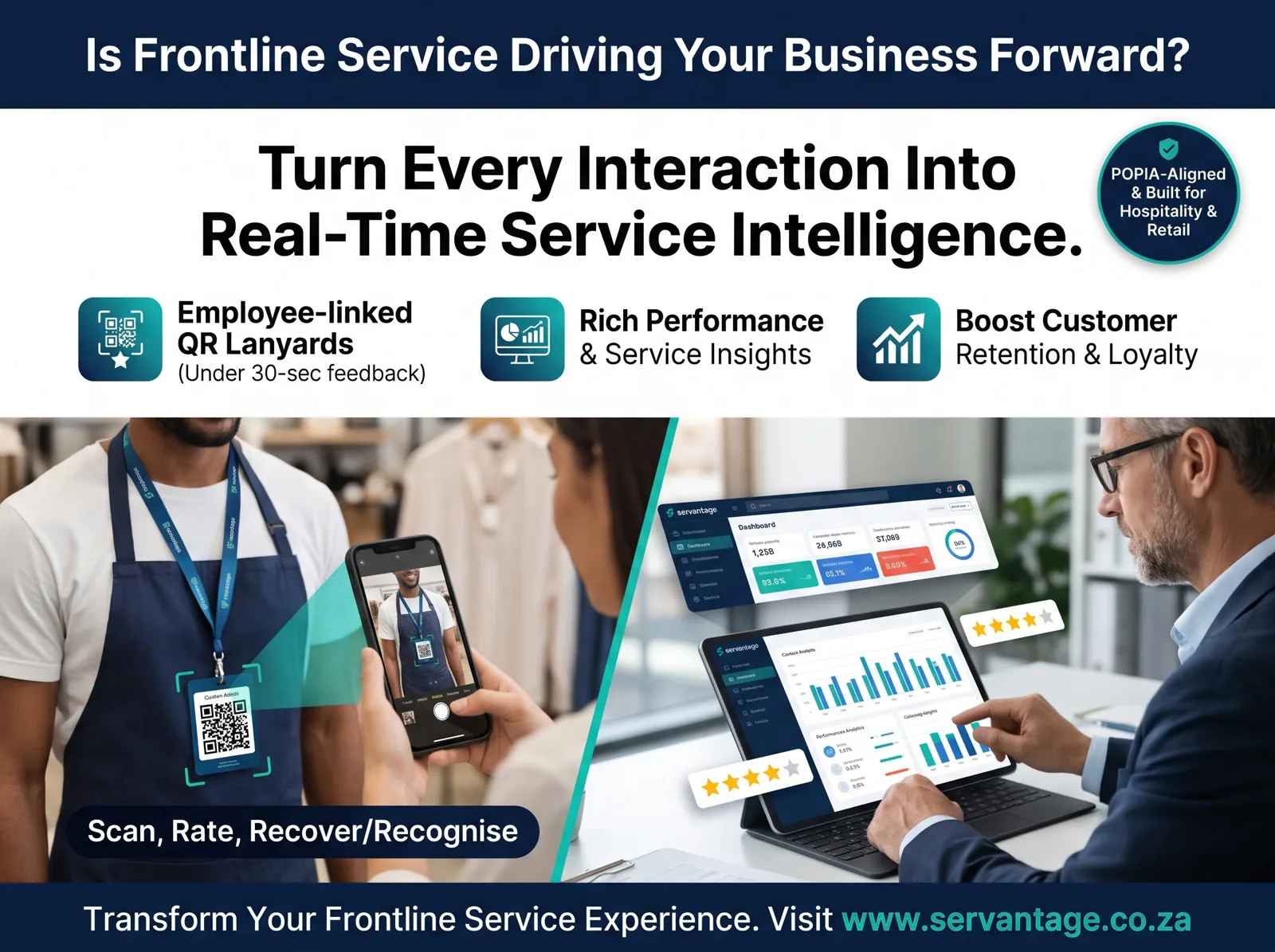
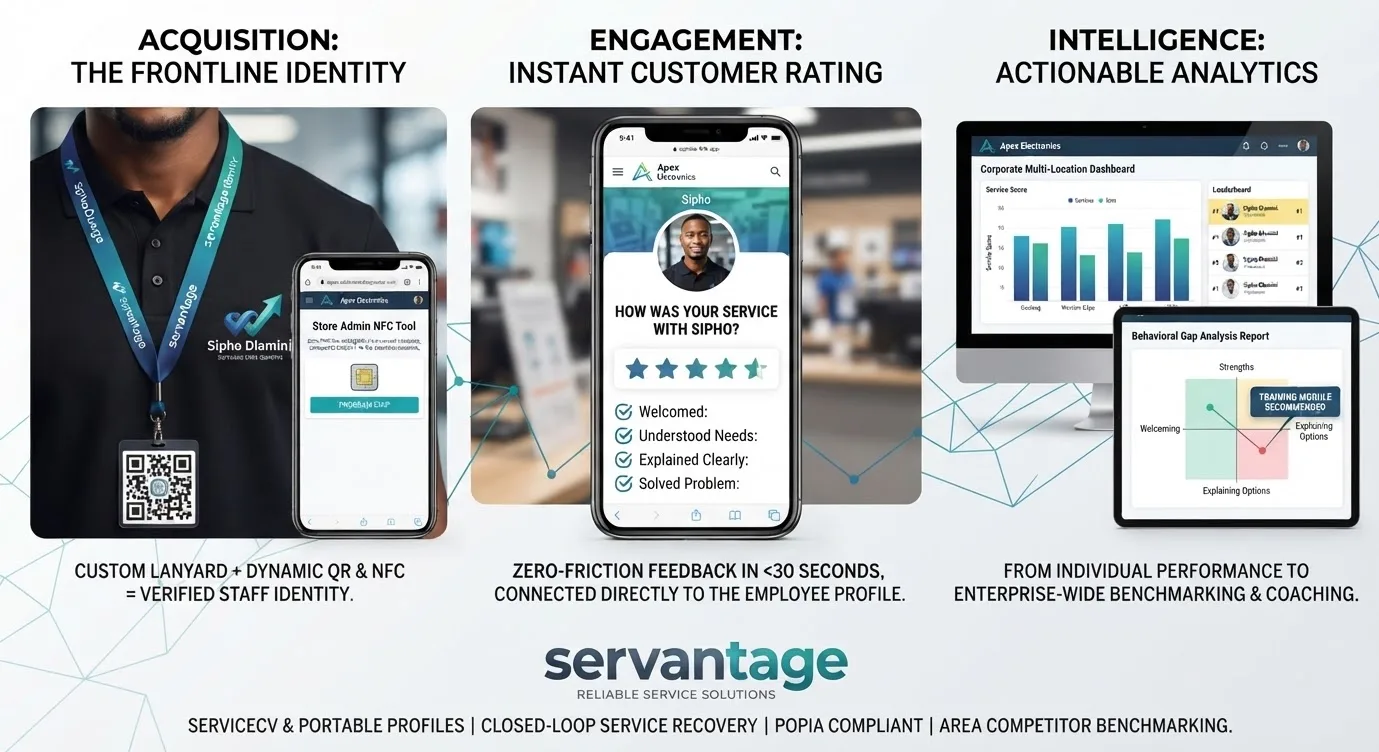
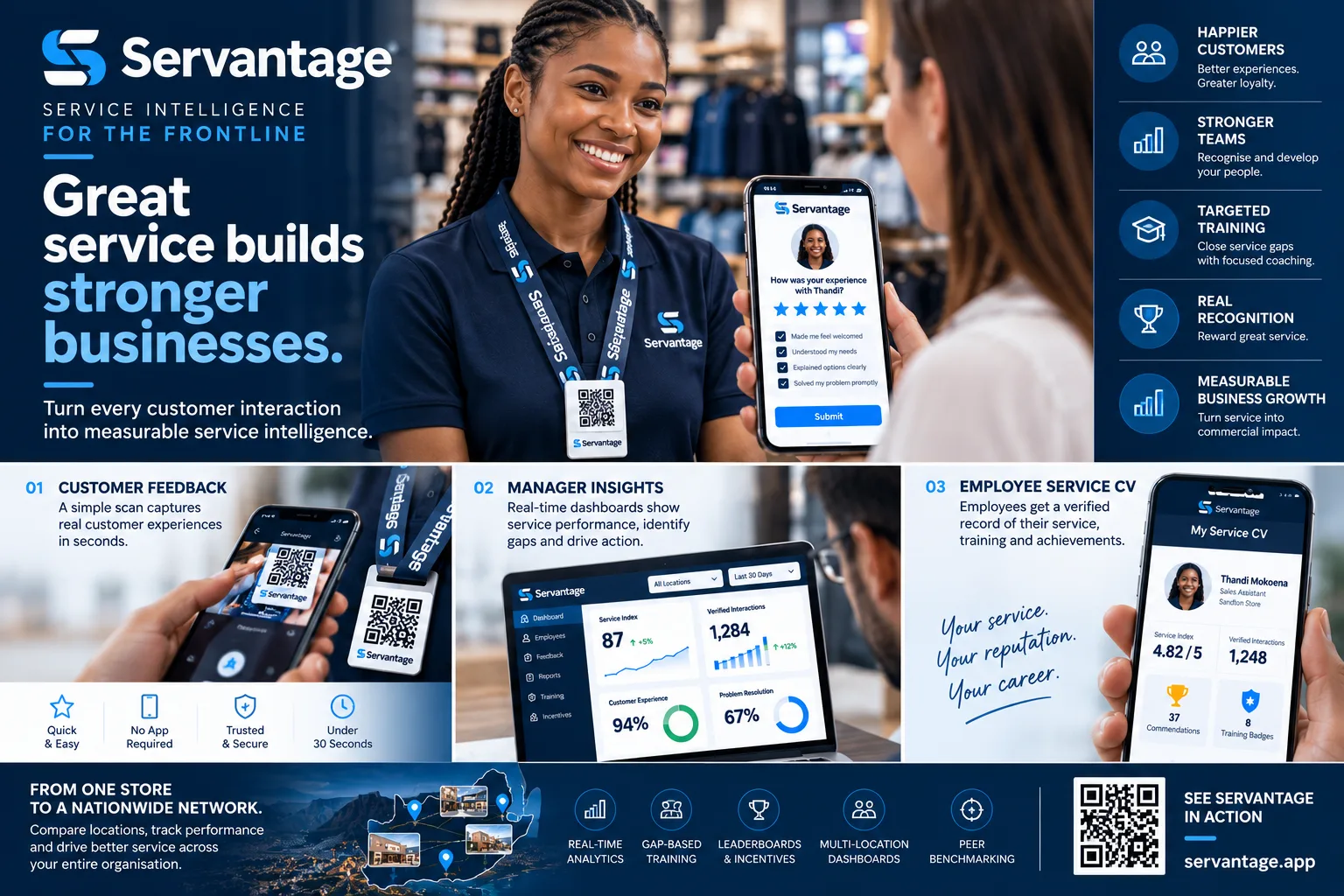
By equipping your team with staff-linked QR lanyards and NFC tags, Servantage empowers your customers to rate the exact employee who served them with a simple tap or scan. Low ratings instantly trigger service-recovery alerts, while high ratings invite public reviews. Meanwhile, your management team gains access to detailed scorecards, gap analysis, and AI-driven coaching to elevate your entire workforce.
Ready to take your customer experience seriously?
Stop guessing what happens on your shop floor. Gain total visibility, empower your staff, and protect your revenue. Try Servantage today and transform your frontline service into your greatest competitive advantage.
Related insights

Sausage Saloon - Case Study
See how Sausage Saloon's Mall of the South pilot used Servantage to boost ratings, measure frontline service, and plan a national rollout.
Frontline experience - the missing link
Discover how measuring the frontline staff experience is the missing link to understanding gaps in service delivery pre sale as opposed to post sale.
The Frontline Advantage: Why Your Staff Are Your Customer Experience Strategy
Frontline staff are the face of your brand and the decisive factor in customer experience. They turn promises into real service moments—resolving problems, building trust, and influencing loyalty. Yet global research shows the risk: 32% of customers would leave a loved brand after one bad experien