The Frontline Advantage: Why Your Staff Are Your Customer Experience Strategy
Frontline staff are the face of your brand and the decisive factor in customer experience. They turn promises into real service moments—resolving problems, building trust, and influencing loyalty. Yet global research shows the risk: 32% of customers would leave a loved brand after one bad experien
Frontline employees are not merely the people who “deliver” a company’s customer-experience strategy—they are the strategy in the moments that matter. From a store assistant resolving a billing error to a call-centre agent calming an angry customer, frontline staff convert brand promises into lived customer reality. Yet many organisations still under-invest in the people who have the greatest direct influence on loyalty, revenue, and reputation.[1][2]
The frontline is where CX happens
Frontline workers include retail associates, contact-centre agents, bank tellers, field technicians, delivery drivers, hospitality staff, healthcare workers, and anyone whose role requires direct interaction with customers. They are usually the first human contact a customer has with a brand—and often the last impression when something goes wrong.
That makes their role commercially decisive. Deloitte notes that frontline workers “can make or break the customer experience,” and that dissatisfied employees are unlikely to deliver excellent service. Workday similarly describes frontline staff as “the human personification of organizations,” because they own the most customer-visible part of the business from day one.[2][1]
The scale is enormous: approximately 80% of the global workforce is estimated to be frontline, yet these employees often receive the least recognition and investment. In the United States alone, frontline workers number nearly 64 million; in the UK, they account for 45% of all employees, or 16.7 million people.[3][4]
What customers remember
Customers rarely remember a company’s internal org chart, its technology stack, or its brand campaign when something goes wrong. They remember whether the person in front of them listened, took ownership, knew the answer, and treated them with respect.
PwC’s global customer-experience research found that 32% of customers would stop doing business with a brand they love after just one bad experience; in Latin America, that figure rises to 49%. In PwC’s more recent 2025 Customer Experience Survey, 29% of consumers said they had stopped using or buying from a brand because of poor customer experience, either online or in person.[5][6]
Human service is especially important. PwC found that 60% of consumers globally would stop shopping with a brand after unfriendly service, while the figure reached 72% in Australia. In other words, a poor attitude at the frontline can undo years of marketing investment.[7]
Customer-experience reality Global evidence
One bad experience can end loyalty 32% of customers would leave a loved brand after one bad experience; 49% in Latin America. [5]
Poor service has direct churn impact 29% of consumers stopped using or buying from a brand due to poor online or in-person customer experience. [6]
Human interaction matters 60% globally would stop shopping with a brand after unfriendly service; 72% in Australia. [7]
Good service drives advocacy Customers reporting good service are 38% more likely to recommend the company than those reporting bad service. [8]
Engaged employees improve outcomes Top-quartile engagement teams achieve 23% higher profitability and stronger customer loyalty. [9]
Engaged staff create better experiences
The connection between employee experience and customer experience is not a soft HR theory; it is measurable business performance. Gallup’s meta-analysis of more than 183,000 business units across 53 industries and 90 countries found that team engagement is consistently linked to customer service ratings, productivity, retention, safety, and profitability.[9]
Gallup also found that top-quartile business units achieve 23% higher profitability than bottom-quartile units, partly because they retain talent, produce higher-quality work, and serve customers better. Engaged teams are associated with 10% higher customer loyalty or engagement, 18% higher sales productivity, and 23% higher profitability.[10][9]
The mechanism is straightforward: employees who feel trusted, supported, and empowered are more likely to go beyond the script. Deloitte reports that frontline employees who believe their organisation delivers on expectations are 2.9 times more likely to go above and beyond, while those who feel the organisation genuinely cares about their well-being are four times more likely to feel motivated.[1]
The global frontline strain
The problem is that many frontline teams are being asked to deliver empathy, patience, and problem-solving while feeling exhausted, unsupported, or invisible.
UKG’s global frontline study found that 75% of frontline employees globally feel burned out, 55% are dissatisfied with their overall employee experience, and 42% say their organisation treats them like a number rather than a person. In retail specifically, UKG found that 79% of frontline workers report feeling burned out at work.[11][12]
This has direct customer consequences. Every percentage point of frontline turnover weakens customer experience and increases training and supervision costs, according to UKG. Workday research also found that 30% of frontline-leading organisations identified poor customer experience as a major impact of turnover, compared with 17% of organisations overall.[13][14]
Customer abuse compounds the pressure. Perceptyx found that 53% of customer-facing workers had recently encountered verbal abuse, threats, or unruly customer behaviour; among retail workers, the figure was 61%. Workers exposed to such behaviour were 1.3 times more likely to be actively job hunting and 1.8 times more likely to say work stress had harmed productivity for more than three days in the past week.[15]
The engagement gap
Globally, employee engagement remains low. Gallup reports that only 20% of employees worldwide were engaged in 2025, while 16% were actively disengaged. Low engagement is expensive: Gallup estimates that low engagement cost the world economy about $10 trillion in 2025, equivalent to 9% of global GDP.[16][17]
For customer-facing businesses, this is not simply an HR statistic. It is a service-quality risk. Gallup found that 69% of engaged employees strongly agree they feel responsible for product and service quality, compared with only 31% of employees who are not engaged or actively disengaged.[18]
That gap shows up in customer promises. Among engaged employees, 45% strongly agree their organisation delivers on customer promises; among disengaged employees, only 12% say the same.[18]
What great organisations do differently
The strongest customer-experience organisations treat frontline enablement as a commercial priority, not an operational afterthought. They recognise that every policy, system, incentive, and management behaviour eventually reaches the customer through a frontline interaction.
1. Hire for service behaviours
Technical ability matters, but attitude, empathy, ownership, and communication often determine whether a customer feels helped. Recruitment should test real service scenarios, not only qualifications.
2. Give staff authority to resolve issues
Nothing damages trust faster than a frontline employee who says, “I understand, but I cannot do anything.” Organisations should define clear empowerment limits so staff can resolve common problems immediately—refunds, replacements, credits, escalations, or service recovery.
3. Invest in practical training
Training should focus on the moments that matter: handling complaints, de-escalating conflict, explaining complex products simply, using systems efficiently, and knowing when to escalate. It should be continuous, scenario-based, and tied to real customer feedback.
4. Fix the employee experience
Burnout, poor scheduling, inadequate tools, and lack of recognition eventually become customer-experience problems. UKG research found that 50% of frontline employees say it is difficult to change shifts at short notice, while 76% feel burned out. Flexible scheduling, fair workloads, better tools, and genuine recognition are CX investments.[13]
5. Use customer feedback to coach, not punish
Customer satisfaction scores should identify coaching opportunities and systemic barriers. If customers repeatedly complain about wait times, billing confusion, or product knowledge, leadership must fix the root cause—not simply pressure the frontline to “smile more.”
6. Connect frontline insight to leadership
Frontline employees hear customer objections, competitor claims, product defects, and unmet needs before anyone else. Companies should create simple channels for staff to report recurring issues and customer insights, then act visibly on that feedback.
A practical frontline CX framework
Organisations can improve frontline-led customer experience by focusing on five levers:
• Clarity: Employees must understand the brand promise, service standards, and their decision-making authority.
• Capability: Staff need product knowledge, systems fluency, communication skills, and conflict-resolution training.
• Capacity: Understaffing and burnout make excellent service impossible; rosters and workloads must reflect real demand.
• Confidence: Employees need psychological safety, manager support, and permission to resolve customer problems.
• Recognition: Celebrate behaviours that create loyalty, not only sales targets or speed metrics.
The commercial case
A frontline-first approach is not philanthropy; it is a growth strategy. Engaged employees deliver better service, customers remain loyal, service failures cost less to recover, and employees stay longer—reducing recruitment and training expense. Gallup’s research links high engagement to stronger customer satisfaction, retention, productivity, and profitability.[9][16]
For any business competing in telecommunications, financial services, retail, hospitality, healthcare, or field services, the conclusion is clear: you cannot build a differentiated customer experience on disengaged, under-supported frontline teams. The brands that win will be those that treat frontline staff as customer-experience creators, brand ambassadors, and a source of competitive advantage—not as a cost centre.
The most important customer-experience investment a company can make is often not another app, chatbot, or campaign. It is the experience of the person serving the customer.[2][1][9]
⁂
How Servantage can help
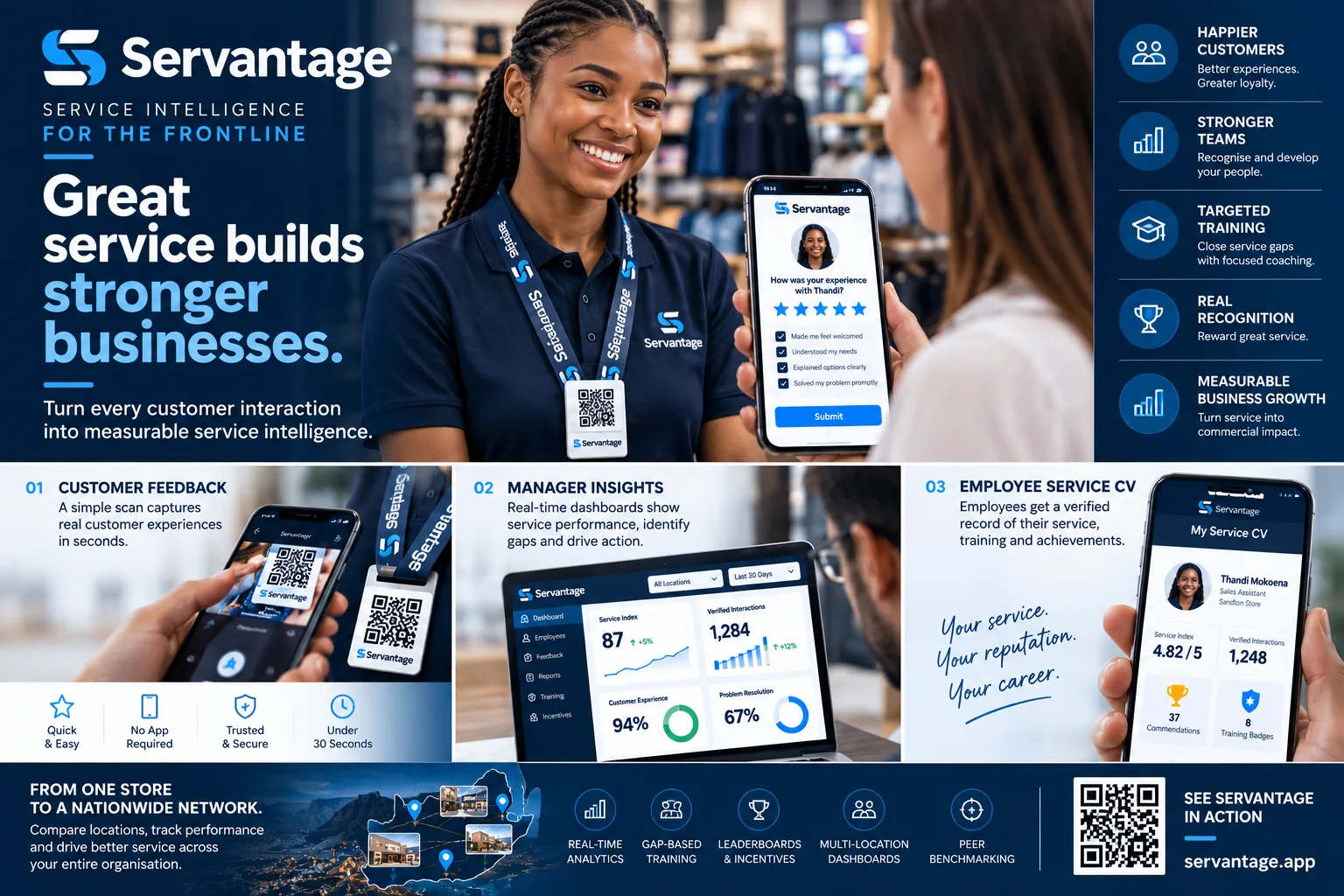
This is precisely the gap Servantage is built to close. Servantage turns everyday frontline interactions into verified service intelligence, helping organisations recognise excellent service, coach where it matters, and connect service quality to commercial outcomes such as repeat visits, basket size, and margin.[50]
Rather than treating customer feedback as a generic survey score, Servantage creates a closed-loop system from the frontline employee to management and the boardroom.[50]
What Servantage provides
• Verified frontline service identity: Each employee receives a QR/NFC-enabled service identity, making the person at the counter visible, accountable, and recognisable as the face of the brand.[50]
• A 30-second feedback moment: Customers scan the employee’s QR code—no app or login required—then provide a quick rating and service-specific feedback.[50]
• The Servantage Service Index: A confidence-adjusted composite score based on quality, confidence, recency, and trust, avoiding the distortion caused by small sample sizes or raw star averages.[50]
• Service recovery, not public damage: Low scores open a service-recovery case so problems can be resolved internally before they escalate into public complaints or lost customers.[50]
• Recognition and a Service CV: Positive interactions become verified commendations, building a portable record of employee strengths, training, and service excellence.[50]
• Commercial linkage: Managers can benchmark outlets, regions, and teams, then connect service behaviours to repeat visits, basket size, and margin using the organisation’s own data.[50]
• Fair, POPIA-aligned design: The platform includes anti-bias and anti-gaming controls, dispute mechanisms, audit trails, data-minimisation practices, and safeguards so ratings trigger fair review rather than automatic punishment.[50]
Why it matters for frontline-led CX
Servantage helps businesses move from assuming good service is happening to measuring, recognising, and improving it. It gives frontline teams a fair way to be seen and rewarded, gives managers practical coaching signals, and gives executives evidence connecting employee service behaviour to customer loyalty and revenue.[50]
For organisations that want to turn frontline staff into a genuine customer-experience advantage, Servantage provides the measurement, feedback, recognition, and accountability layer needed to make service excellence repeatable.[50]
Learn more at www.servantage.co.za.[50]
Citations
1. https://www.deloitte.com/us/en/industries/consumer/articles/human-capital-frontline-management.html
2. https://blog.workday.com/en-ca/the-hidden-cost-of-overlooking-frontline-worker-well-being.html
3. https://www.forbes.com/sites/moorinsights/2025/08/11/what-a-workvivo-study-reveals-about-the-frontline-gap/
4. https://www.catalyst.org/en-us/insights/2025/customer-experience-starts-with-the-front-line
5. https://www.pwc.es/es/publicaciones/retail-y-consumo/assets/pwc-consumer-intelligence-series-customer-experience.pdf
6. https://www.pwc.com/us/en/services/consulting/commercial-excellence/library/2025-customer-experience-survey.html
7. https://www.pwc.com.au/retail-consumer-markets/report-cis-future-customer-experience.html
8. https://www.freshworks.com/customer-service/statistics/
9. https://www.gallup.com/workplace/649487/world-largest-ongoing-study-employee-experience.aspx
10. https://www.gallup.com/workplace/285674/improve-employee-engagement-workplace.aspx
11. https://www.ukg.com/sites/default/files/2025-09/FY25_Perspectives from the Frontline Workforce A UKG Global Study_ResourcePDF.pdf
12. https://www.ukg.com/sites/default/files/2025-10/FY25_MC253_Retail 2025 Holiday survey_Final_.pdf
13. https://www.ukg.com/blog/operations-leaders/frontline-first-companies-are-thriving-heres-how-they-do-it
14. https://blog.workday.com/content/dam/web/en-us/documents/reports/20220629-workday-longitude-frontline-workers-research-project-enus.pdf
15. https://blog.perceptyx.com/new-research-reveals-the-toll-of-the-unruly-customer-on-frontline-workers
16. https://www.gallup.com/394373/indicator-employee-engagement.aspx
17. https://www.gallup.com/workplace/229424/employee-engagement.aspx
18. https://www.gallup.com/workplace/702329/staffing-eroding-customer-experience.aspx
19. https://link.springer.com/article/10.1007/s11628-025-00589-z?error=cookies_not_supported&code=b0abeaa5-6f87-4978-a8c9-01d63b4e89e5
20. https://blog.perceptyx.com/customers-behaving-badly-your-frontline-workers-are-paying-the-price
21. https://blog.workday.com/en-us/workday-study-approach-workforce-management-fit-new-frontline-experience.html
22. https://www.jll.com/en-sea/insights/high-performance-workplace-for-frontline-workers
23. https://www.jll.com/en-us/insights/high-performance-workplace-for-frontline-workers
24. https://blog.webex.com/customer-experience/twenty-five-customer-experience-statistics-for-2025-and-why-they-matter/
25. https://www.pwc.com/cb/en/services/consulting/pdf/customer-experience-placemat.pdf
26. https://www.gallup.com/workplace/659279/global-engagement-falls-second-time-2009.aspx
27. https://www.pwc.com/us/en/services/consulting/commercial-excellence/future-customer-experience-is-supply-chain.html
28. https://www.pwc.com/us/en/technology/alliances/library/2025-cx-survey-oracle.html
29. https://www.gallup.com/workplace/645416/key-insights-global-workplace.aspx
30. https://www.cm.com/blog/avoid-losing-one-third-of-your-customers-in-one-day/
31. https://www.ukg.com/learn/resources/white-paper/more-perspectives-frontline-workforce
32. https://www.catalyst.org/insights/2025/customer-experience-starts-with-the-front-line
33. https://www.forrester.com/press-newsroom/forrester-global-customer-experience-index-2025-rankings/
34. https://www.zoom.com/en/blog/employee-experience-statistics/
35. https://we.workforimpact.com/hubfs/Campaign Files/CX Trends Report 2025.pdf
36. https://www.businesswire.com/news/home/20260105799231/en/Global-Study-Reveals-Flexibility-and-Financial-Wellness-Are-Top-2026-Priorities-for-Frontline-Workers
37. https://www.pwc.com/us/en/technology/alliances/library/salesforce-customer-experience-survey.html
38. https://www-pwc-com-dpe-dev.pwc.com/us/en/services/consulting/business-transformation/library/building-customer-loyalty-guide.html
39. https://www.pwc.com/us/en/library/trust-in-business-survey/customer-trust-in-your-sector.html
40. https://www.pwc.com/gx/en/industries/consumer-markets/consumer-insights-survey.html
41. https://www.ppai.org/media-hub/businesses-missing-the-mark-in-customer-experience/
42. https://www.gallup.com/workplace/236366/right-culture-not-employee-satisfaction.aspx
43. https://www.gallup.com/workplace/506798/globally-employees-engaged-stressed.aspx
44. https://www.gallup.com/workplace/349484/state-of-the-global-workplace.aspx
45. https://www.gallup.com/workplace/236927/employee-engagement-drives-growth.aspx
46. https://www.gallup.com/workplace/393497/world-trillion-workplace-problem.aspx
47. https://www.gallup.com/workplace/321032/employee-engagement-meta-analysis-brief.aspx
48. https://www.gallup.com/workplace/321725/gallup-q12-meta-analysis-report.aspx?thank-you-report-form=1
49. https://www.gallup.com/workplace/290573/engaged-workplaces-world-put-people-first.aspx
50. https://www.servantage.co.za/